16/07/2011

projeto research-Terra: novos recursos


Caros amigos e colegas,

Desde o seu início, em Março de 2010, o projeto Research-terra tem crescido consideravelmente. Temos agora um novo URL URL - http://www.research-terra.com/ - e um novo email - email@research-terra.com.

O projeto research-Terra começou por ser uma simples página de internet que continha apenas alguns títulos de teses desenvolvidas sobre a construção com terra, restringindo-se a alguns países da Europa. Hoje, graças à participação de muitos leitores que nos enviaram amavelmente informação, contamos com uma lista de trabalhos realizados em 16 países espalhados do mundo. Adicionalmente, o research-Terra encontra-se em fase de expansão para incorporar outros aspetos relacionados com a construção em terra no mundo.
No futuro, esperamos funcionar numa plataforma que, para além de ligações, possa também alojar os mais variados documentos e bibliografia para que o conhecimento seja diretamente acessível a todos.

A equipa do projeto research-Terra está de momento a trabalhar para tornar esta plataforma NA ferramenta de referência para todos os interessados e envolvidos na temática da construção em terra. Como tal, mesmo sendo ainda um trabalho em progresso, incluímos já novas funcionalidades e recursos na nossa página – nomeadamente perfis de profissionais ligados à terra e imagens de construção em terra pelo mundo. O objetivo é facilitar o encontro de pessoas e especialidades nesta área.
Caso desejo ter o seu perfil adicionado à página do research-Terra, assim como enviar fotografias, poderá fazê-lo seguindo as instruções presentes no website.

Como sempre, contamos consigo para tornar possível o objetivo de unir a investigação com a prática profissional da terra num só sítio. Tudo o que precisa fazer é enviar-nos a informação que gostaria de ver online, seguindo as instruções disponíveis no site.

Acreditamos que, com a sua colaboração, este pode ser o começo de algo muito interessante!


De seguida encontra-se uma breve descrição de características da research-Terra:


Novos recursos

IMAGES - IMAGENS - edifícios de terra em imagens:
Sabe-se que existem diversas formas de usar a terra como material de construção. Deste modo, esta página tem a intenção de criar álbuns de fotografias divididos por países. Pretendemos expor exemplos de construções em terra espalhadas pelo mundo, no qual poderá participar enviando as suas fotos!


PROFILES – PERFIS - Perfis curtos de pessoas envolvidas na construção em terra:
A fim de complementar a secção já existente de grupos de investigação, adicionámos os perfis contendo um resumo das atividades levadas a cabo por pessoas relacionadas com a construção em terra (profissionais, de caráter académico, etc.). Se assim o desejar, poderá ter seu nome adicionado à lista de perfis - ver como na página de perfis.
Apesar de acreditarmos que o seu perfil em Inglês seria compreendido por um público mais alrgado, poderá enviar-nos o perfil na língua que entender ser a mais apropriada.


Recursos existentes

RESEARCH – INVESTIGAÇÃO: Um dos objetivos principais do research-Terra é ainda o de promover e divulgar a pesquisa sobre a construção em terra feita pelo mundo. Por este motivo, a sua contribuição continua a ser fundamental. Caso tenha levado a cabo investigação de caráter académico sobre a construção em terra, pode adicionar o título da mesma à base de dados do research-Terra, usando as instruções disponíveis no website. O mesmo se aplica às restantes páginas – RESEARCH GROUPS, BIBLIOGRAPHY, EVENTS e LINKS.


A equipa do research-Terra deseja agradecer a sua colaboração!


research-Terra - new features!!


Fellow readers,

Since it was first created, the Project research-terra has been growing considerably. We now have a new logo, a new URL - http://www.research-terra.com/ - and a new webmail - email@research-terra.com!

Research-Terra started has a simple website containing some titles of thesis on the various aspects of earthen construction developed by researchers in European countries. Today, research-Terra has not only expanded to include research from all over the world, but is also embracing all sorts of fronts in this field.

The research-terra project team is currently working towards making the webpage THE reference tool for all of those involved in earthen construction throughout the world. Therefore, we have included new features - namely profiles and photos - which will provide a bigger picture of what is taking place within the earthen building community worldwide.

As before, we are counting on you to make this possible! All you have to do is send us the information you would like to see online, by following the instructions available on the website.
It is still a work in progress, however, we believe that, with your help, this can be the start of something interesting!

Here is a short description of research-Terra’s features:


New features

IMAGES - Earthen buildings in pictures:
It is known that there are many forms of using earth as a building material. Following that, this page intends to create photo albums divided by countries to show examples of earthen buildings throughout the world. You can participate by sending your photos!


PROFILES - Short profiles of people involved in earthen construction:
In order to complement the already existing section of research groups we have added profiles with a summary of people’s activities related to earthen construction. You can have your name added to the list as well – see how on the profiles page.
Although we believe that your profile in English would be comprehended by a larger audience, you are free to send us your profile in your native language.


Existing features

RESEARCH: One of research-Terra’s main goal is still to promote and disseminate the research on earthen construction, for this reason, the RESEARCH page still requires your contribution. If you have done academic research on earthen construction, access this page to see how you can add this information to the website. The same goes for the other pages - RESEARCH GROUPS, BIBLIOGRAPHY, EVENTS, and LINKS.


We look forward to receiving your input.

The research-Terra team wishes to thank you for your cooperation!

12/07/2011

Two articles worth reading - Slum upgrading

Two articles worth reading.


Between the “informal” and the “formal”: Slum upgrading in South Africa
June 28th, 2011
By Benjamin Bradlow, SDI secretariat

Building a bridge between the “informal” and the “formal”

In January, the South African SDI Alliance affirmed a vision to build city-wide networks of informal settlement communities that mobilize to upgrade their settlements. Nearly six months later, about 30 representatives of the Alliance partners — the Informal Settlement Network (ISN), Federation of the Urban and Rural Poor (FEDUP), Community Organisation Resource Centre (CORC), iKhayalami, and uTshani Fund — met in Cape Town to reflect on the upgrading work that has been accomplished thus far. (read more...)

_______________________

Source: UN-HABITAT

Understanding of residents’ needs and aspirations central to slum upgrading, say urban practitioners
Nairobi, 1 Jul 11

Local and international actors working on slum upgrading have emphasised the importance of understanding the wide range of views of residents when working to improve the standard of living in urban areas.

The comments were made at an international meeting called 'Change by Design' which was held at the UN Headquarters in Nairobi in June, and co-organised by Architecture Sans Frontieres UK (ASF-UK), The Pamoja Trust, and UN-HABITAT's Housing Policy Section. The event is part of UN-HABITAT's Shelter Initiative for Climate Change Mitigation and Adaptation (SICCMA) which aims to contribute to the development of affordable housing that is also sensitive to the environment and social and cultural advancement.

More than 100 participants, including 25 international experts and architecture practitioners, participated in the one-day symposium which focused on the institutional, urban and architectural opportunities and constraints to developing participatory community-led slum upgrading programmes. (read more...)

11/07/2011

Eco-cities: who can afford them?

'Are you torn between living green and living in the heart of the city? Now you can do both! Take a tour of Europe's eco-cities, starting with Stockholm's trendy neighborhood of Hammerby Sjostad, along with London and its BedZed, and finish with IssyGrid, the first French smart grid project. Ready for the ride?'


It is known that cities are a major source of CO2 emissions, much of it directly or indirectly involved with the built environment. This fact has been contributing for a definite shift in the mindset of those living and building the cities. The increasingly higher numbers of environmentally conscious housing developments, such as the ones shown on the video are proof of that.
However, something is often not mentioned but can be easily picked up from these sorts of videos/articles/interviews. The fact is that, in order to be able to live in these ‘eco-cities’ (or eco/green/bio/sustainable cities...)  one usually has to pay a considerable high price.
The truth is that it has become fashionable to live in a place like Bed Zed. Those who are not lucky enough to own a house there can get a glimpse of the place through guided tours! According to the bioregional website ‘thousands of people visit BedZED every year’ (Opening hours are from 9.30am to 5.00pm, Monday to Friday, except bank holidays), and I am sure the same happens in other places such as this.

Apparently, and according to THIS article, 'Research has shown that buyers are willing to pay up to a 20% premium for innovative design and green features such as those at BedZED'.Why? Well, maybe because 'the average BedZED resident still presently releases a massive 56% less carbon dioxide than the average English citizen' the same article states...

Of course, overall, these housing developments certainly have many positive outcomes, but I cannot help wondering just how this fact fits in the sustainability agenda. Sustainable cities, YES, but for whom?

3 years!

Three years have passed and it still seems like yesterday that I posted here for the first time.
20 000 visits from all over the world may not seem much (I have seen blogs with much more than that!), but it is certainly enough to keep me going :) And I have you to thank for that.
This year will be a very exciting one to post: as I head towards the final stage of my research I will spend some time in Ghana and Angola from September and hopefully will also start sharing thoughts, ideas and pictures on the construction of my own little earthen house in Portugal... So, please do stop by, your visit is, as always, more than welcome!
See you soon!!

08/07/2011

Solar Sinter 3D-printing machine - video

via: Dezeen.com

German designer Markus Kayser has built a 3D-printing machine that uses sunlight and sand to make glass objects in the desert.
Called The Solar Sinter, the device uses a large Fresnel lens to focus a beam of sunlight, creating temperatures between 1400 and 1600 degrees Celsius. This is hot enough to melt silica sand and build up glass shapes, layer by layer, inside a box of sand mounted under the lens. Solar-powered motors move the box on an x and y axis along a computer-controlled path and a new layer of sand is sprinkled on top after each pass of the light beam. Light sensors track the sun as it moves across the sky and the whole machine rotates on its base to ensure the lens is always producing the optimum level of heat. Once all the layers have been melted into place the piece is allowed to cool and dug out from the sand box. Kayser developed the project while studying on the MA Design Products course at the Royal College of Art.


07/07/2011

Sustainable Building Practices in Botswana - boidus.co.bw

I have just come across the website boidus.co.bw, which is a network and platform of discussion of architecture in Botswana. 

Amongst other interesting articles, you can find a 3 part essay on the subject of sustainability in the built environment, focusing on the context of Botswana. With these articles the author intends to 'continue discussions that have been started by G. Manowe (writing for Sunday Standard) on the subject of sustainability in the built environment.'. He further discusses 'sustainability in the context of buildings and settlements as; building processes that are environmentally responsible and resource-efficient throughout a building’s life-cycle; from sitting to design, construction, operation, maintenance, renovation, and demolition (Green Building, MIT).' 
The author addresses issues of Climatic Elements, Building Design and Measuring Sustainability; International Rating Schemes.

In case this subject interest you, here are the links for all 3 parts of the essay.

Sustainable Building Practices in Botswana: Part 1
Sustainable Building Practices in Botswana: Part 2
Sustainable Building Practices in Botswana: Part 3

03/07/2011

Ecovillages and Sustainable Living Conference 2011 - Portugal

This year the Ecovillages and Sustainable Living Conference will take place in the South of Portugal, in a wonderful ecovillage called Tamera. Having been there before, I strongly recommend attending, not only for the conference itself (which I imagine should be quite interesting), but also to enjoy the experience of spending some time in an idyllic place! Since I have spent a week there, a few years ago, I have been telling myself that I must repeat the experience. Unfortunately it will not be this time... Maybe next year.
Hope you can make it!


7. Jul 2011 - 11. Jul 2011 in Tamera ( Portugal )

This conference will give participants a deeper understanding of cutting edge developments of the Global Ecovillage Network (GEN), focusing on GEN-Europe, Africa and the Middle East. Opportunities will be provided to learn about and practice facilitation methods and pedagogies used during the conference (experiential learning, action learning, participatory learning, incorporating the wisdom and diversity of participants). This year there will be a special focus on the dimension of education.

Ecovillages act as research and training centres for sustainable development within wider society. The hosting Ecovillage of Tamera serves as a living example and field of practice for the themes of the conference.

The themes of this year’s conference include:
Collaborations for Sustainability – Inspirations from the Global Ecovillage Network
New developments in the Global Ecovillage Network, with a focus on Europe and Africa. In-depths exploration of Tamera’s solar village and water landscape in theory and practice.
Widening networks for Resilience – Broadening the concept of 'Ecovillage'
Transition of traditional villages to ecovillages. Interaction and cooperation with academia, social entrepreneurs and policy makers. Ecovillages and Transition Towns. Empowered Fundraising.
Education for Sustainability - GEN-Strategies
Ecovillage Design Education – Gaia Education. Presentation of the new two-year curriculum ‘Transition to Resilience – Learning Adventure for Change Agents’. Children and Youth.

The conference will be facilitated by Capra Carruba and a team.

The presenters and facilitators of workshops are : Kosha Anja Joubert ( South Africa, Germany and Scotland, UK ) , Macaco Tamerice ( Germany and Italy), Adama Ly ( Senegal ), Lua Bashala-Kekana ( Congo and South Africa ), Nara Petrovic ( Slovenia), John Croft ( Australia and Germany ), May East ( Scotland, UK and Brasil ). Other presenters to be confirmed…

Each day of the conference will start with lectures in the mornings, followed by mini-workshops in smaller groups to deepen one of the themes of the morning. There will be lots of opportunities to get to know the other participants and more informal exchange.
The Venue

Tamera in Southern Portugal is an international training and experimental site for the development of peace research villages and healing biotopes worldwide. Approximately 200 people live, work and study in Tamera. Tamera’s aim is to develop an example of a model for a non-violent co-existence of people and between people and nature.

Simple living is an important value in Tamera and the accommodation is mostly in dormitories and big tents with floors and beds. Some rooms with simple standard are available in the guest houses. All accommodation is within walking distance to the conference site.

The community kitchen in Tamera prepares vegan, organic meals with as many local and regional ingredients as possible.


For more information on fees and registration click HERE

28/06/2011

Paul Jaquin's new book - Earth Building: History Science and Conservation

Following his PhD on Analysis of historic rammed earth construction, Paul Jaquin has written the book Earth Building: History Science and Conservation. Although it will only be out in November it is already available to pre-order on Amazon.

Update on Research.Terra


Just to let you know that the website Research.Terra has been updated with lots of new thesis on earthen construction. We now have roughly 120 titles from 14 different countries! Moreover, the bibliography list is getting longer and longer by the day.


As usual, if you are aware of any publication (thesis/book/paper, etc.) that is not yet on the website, please just let us know via research.terra@gmail.com.

27/06/2011

Earthen buildings today...

A few weeks ago I have received a link to Patricio Arias new website, which made me think about what it meant to build with earth today.

Patricio Arias is an architect from Chile who is definitely amongst the group of very talented people – such as Rick Joy, Plano B, Martin Rauch, Marcelo Cortes (with whom he has worked) – looking at the current use of earthen materials as a product of our time and, therefore, bringing earth as a building material to the mainstream of the building industry.

Although I still struggle a bit with the concept of ‘contemporary earthen architecture’ (I shall leave this issue to a later post), I have to say that I have seen quite a lot of examples of buildings that would qualify as such. However, Patricio’s approach differs substantially from all of what is already out there.
I met Patricio in a conference last year and have been following his work ever since. I was able to witness his enormous passion for architecture in general and, in particular, for the way earth can be used to meet current needs and demands. Patricio Arias’ work reveals a deep understanding of both architectural space and the essence of building materials. Moreover, he makes a clear statement with his buildings by proclaiming to the world that it is possible to create extraordinary architecture with earth, using one or several of its many associated construction techniques. His architecture emerges from within its time and context, and reveals that, no matter what the future brings in terms of fashion or architectural styles, the same approach can be pursued and successfully accomplished.
As always, some criticism has also been made about the use of the main technique used by Patricio – tecnobarro (or quincha metalica). This was mostly to do with the introduction of steel as a structure for the earthen walls. Those who are more “purists” in what concerns the use of earth as building material often question the compatibility of earth with concrete or steel. In a way I can understand this concern, especially since there are complex chemical processes involved in the heat and humidity transfer of unbaked earthen materials. This is the reason why, for example, one usually combines natural insulating materials (such as cork or sheep wool) with earthen building elements. Nevertheless, I am not aware of any studies that have been carried out in order to test this theory. I had this same conversation with Patricio, who was very interested in finding out whether the thermal performance of the buildings he designs is in any way influenced by the use of steel.

In addition to the thermal performance, I would probably add a very current issue – the ecological footprint and environmental impact of quincha buildings. Apparently, the overall sustainability of these buildings may be somewhat compromised, due to the energy intensive overall construction process (when compared to traditional earthen building techniques). Not only some of the materials have a high embodied energy, but also mechanical methods are used throughout.

Again, I am certainly not an expert in this type of earthen technology, nor can I refer to any study that has been carried out to share some light on this particular subject; however, one has to wonder about the viability of applying this technique to other, perhaps not so resourceful, contexts.

While some features may be questioned, others are without a doubt, very positive. This consists of a very effective seismic resistant construction. Once more, I refer to what Patricio stated himself after the last major earthquake in Chile: his houses were not affected, whereas others have literally crumbled apart.

In my opinion, we do not always have to have a definite answer or solution for every problem encountered, there is no such thing as a universal thruth... Patricio’s buildings are incredibly interesting and appealing as architectural objects. One cannot help but feeling fascinated by them. Further to this, they bear witness to the immense possibilities and flexibility of this building material and probably are providing a view into what the future of earthen materials will be.

The main question raised here, which can easily be applied to a more general architectural universe, is whether or not the future of earthen buildings will still be one of sustainability above all? By employing mechanical processes, are we contributing towards the increase of CO2 emissions? Will that also mean that earthen buildings will not be as low-cost as they are known for? Who will be able to afford these high-quality earthen houses?

On the other hand, I can also envisage a myriad of positive aspects arising from the combination of modern technologies with such an ancient building material. One only has to look at the photos below to understand that the preconceived ideas that usually associate earth with backwardness and poorness are indeed obsolete. And this, my fellow readers, the social perception, has been the paramount obstacle against the use of earthen materials today.

For this reason, and just to conclude for today, it is my belief that if it takes a bit of a compromise in order for people to accept once and for all that “earthen architecture” is just Architecture, then I am not against some kind of hybrid approach, where one can make use of the good natural features of earth and today’s technological advances in the field of architecture and engineering.

See you soon!


Some examples of buildings designed by Patricio Arias. All images have been sourced from his website http://www.patricioarias.cl/Index.php/

22/06/2011

Oxford Brookes University - End of the Year Show 2011


Like every year, Oxford Brookes - School of the Built Environment - and the students have organised an exhibition with the work developed throughout the academic year, in which the research students also participated.
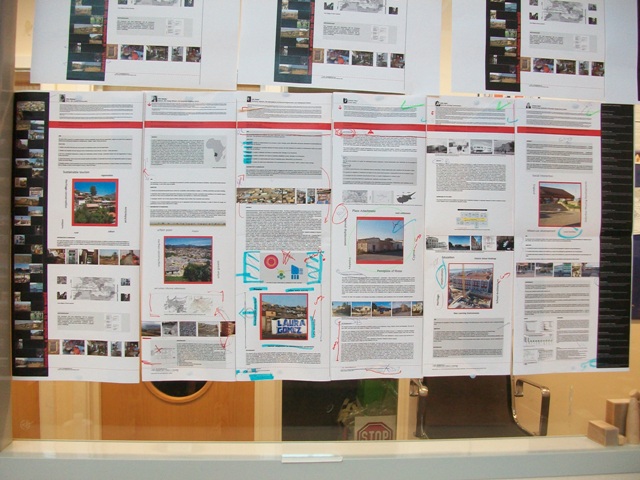
A few of us thus got together to design and build a panel to display some of the work currently being developed by the research students. Although we did not have any fancy 3d images of building projects, the intention was to somehow convey the idea that research is not necessarily boring, as many tend to think, and can actually be quite exciting. The general feedback was quite positive, so hopefully we were successful...
The authors and respective titles of the work displayed in our area were the following:
  • Aliye Mentesh - Sustainable tourism-led rural regeneration as a tool for conserving cultural heritage and architectural traditions: the case of Cyprus in its regional context
  • Célia Macedo - The use of earthen construction for sustainable dwellings in Angola
  • Julia Wedel - The impact of power differentials on adaptive opportunities in the context of water scarcity in an informal settlement in Lima, Peru
  • Makbule Oktay - Place Attachment and Perception of Home in Rural Settlements of northern Cyprus: Adaptation after Internal Displacement
  • Sofia Aleixo - Historic School buildings Conservation: impact of adaptation to new Education needs in the heritage value
  • Susanne Dahm - The role of local facilities in fostering social interaction in suburban housing developments in England 
There are many other students, carrying out interesting research, whose work was not represented at the exhibition. In case you are interested to know a bit more about their work click HERE.
The exhibition was open from the 7th until 17th June in Oxford and is now moving to London - details HERE.

Overall, adding to the positive experience, it was good to focus our attention on something that does not involve reading or writing for a change. I am already looking forward to the exhibition next year, which, if all goes well, will also be the final year of my PhD!

If you would like to look at a sample of the work developed here at Oxford Brookes in the School of the Built Environment just download the Yearbook 2011 available from Brookes website.

15/06/2011

Where to?

The roof has not yet been blown away by the wind. Lately I have been giving a lot of thought into what exactly should go on these pages following the 3rd anniversary of the roof above my head. Although the main driver behind its initial posts was indeed earthen construction - as well as other natural building technologies - somehow the passive role of simply promoting events, publications and so on, does not seem as fulfilling as before. Not that I think that there is anything wrong with providing this information to readers, however, to be honest, I feel that this should now be complemented with a more personal touch.


In fact, since I initiated my research, my interests have been shifting a bit from looking at earthen building technology as an isolated topic, to embrace all sorts of socio-cultural, economic and environmental implications of its use, particularly in developing countries. Therefore, although the promotion of events is always a good reason to post, in the future I will mostly try to use this platform to critically approach projects, thoughts, ideas, concepts, etc., more in line with the above-mentioned. Hope you enjoy stopping by!

See you soon!

03/03/2011

Earth USA 2011

Earth USA 2011 will take place September 30, October 1 and 2, 2011 at the National Hispanic Cultural Center in Albuquerque, New Mexico - USA.

This is the Sixth International Earthbuilding Conference sponsored by Earth USA (emerging from the Adobe Association of the Southwest), the Adobe Construction Program of Northern New Mexico College, the National Hispanic Cultural Center and Adobe in Action.

Earth USA 2011 indicates a wider field of interest than previous conferences and will include adobe, rammed earth, compressed earth block: CEB, and monolithic adobe: cob. Any material or method that uses clay as a binder is considered.

Paper subject categories are:
  1. Historic buildings and cities including their stabilization, preservation and conservation
  2. Education and information transfer including codes, norms and regulations
  3. Physical and thermal properties of materials and structures including seismic, flood and storm resistance
  4. Construction methods
  5. New architecture and construction projects including renovation, modernization and re-purposing of existing buildings
  6. Poster session
Submit your abstract as an e-mail attachment in .DOC format no later than May 3, 2011. Please address your e-mail to:

Quentin Wilson, Speakers Committee
earthusa.org@gmail.com

For more information and to download the abstract template visit:
www.earthusa.org

Conference Languages:
Spanish and English: Simultaneous translation of presentations from the podium is not anticipated without surprise funding sources. Papers will be printed in the 2011 Conference Proceedings in the language received. Papers received with translations will be printed in both languages. PowerPoint presentations are encouraged to be labeled in both languages.

Conference Fee:
Conference registration will cost $185 USD for a 2-day pass (Sept. 30 & Oct. 1) with a reduced price for students. Authors and presenters also pay the registration fee. Earth USA 2011 is a small conference with few financial resources. A one-day tour to local earthbuilding sites will be available on Sunday, Oct. 2 with the cost still to be determined. Four and five-day earthbuilding courses and workshops are being planned from October 3 through 7 and will include topics such as basic adobe construction; rammed earth construction; arch,vault and dome construction and lime plasters.

Accommodations:
Hotels with special rates will be announced shortly. Early hotel reservations are advised since the Albuquerque International Balloon Fiesta is running parallel to the conference. Campers might consider the Rio Bravo State Park south of the National Hispanic Cultural Center on Isleta Boulevard. Meals will be available at La Fonda del Bosque - the restaurant on site at the National Hispanic Center. Other restaurants can be found in the immediate area.

28/02/2011

More courses on sustainable building techniques - Portugal

Fancy a trip to Portugal to learn about sustainable construction techniques? TerraCrua Workshops is organising several courses between 19th March and 17th June.

Programme:


- 19th & 20th March - Manufacture and adobe construction Manufacture of adobe bricks, building walls and other structures. 

- 26th  &27th March - Construction of oven.
We will build a furnace 2mts in diameter, using clay and old tiles. 

- 9th & 10th April - Construction in COB Grout and construction of a structure in Cob. We will also work on a rocket stove. 

- 30th April  &1st May - Adobe Construction 2 Manufacture and adobe construction.
We will build a dome and an arch. 

- 7th & 8th May - Sands, plaster, clay and mortar Select sand and clay, several mortars for various purposes. Plasters, adobe and cordwood, several mortars and plasters. Lime vs Cement Straw, sawdust and cork in mortar

- 28th, 29th & 30th May - Oven & Bread Day 28th - Workshop on homemade bread  

- Days 29th & 30th - Construction of oven 

- 18th & 19th June - cordwood and bottles We will build a cordwood and bottles wall , with plaster of sand and lime

-Location: Vale dos Coiços, Góis

-Price: € 40 per workshop, except OVEN & bread, which is € 50

Includes camping area, basic structures such as shower and dry toilet; -Includes lunch and dinner on day of workshops;

-Confirmed Participants must arrive the day before the workshop to set up camp;
Further information and registration: oficinasdaterracrua@gmail.com

27/02/2011

Learning from nature - Bird's earth nest

Wonderful slideshow showing a bird building its nest out of earth. Could not resist and had to post this on my blog... Enjoy!

25/02/2011

Upcoming earthen construction courses/workshops/conferences

Conferencias LA TIERRA CRUDA: un material de construcción actual
ENTRADA LIBRE - Se entregará certificado de asistencia
Programa:

Miércoles 16/03
9-10. Fuentes documentales para su difusión e investigación. Mercedes Ponce.
10-11.30. Adobes y entramados: caracterización y aplicación. Ana González.
12-13.30. Tapia: caracterización y aplicación. Jacinto Canivell.
13.30. Mesa redonda


Miércoles 23/03
9-11. El revoco: caracterización y aplicación. Laurent Conquemont.
11.30-13.30. La construcción actual con tierra cruda. El caso portugués y español. Francisco Seixas.
13.30. Mesa redonda
Salón de actos de la Escuela Técnica Superior de Arquitectura de Sevilla.

Av. de Reina Mercedes. Sevilla, España.

__________________________________________

TALLER INTERNACIONAL DE ARQUITECTURA SOSTENIBLE CON TIERRA
realizarse en Subachoque, Colombia.
Marzo 11 al 20 de 2011

El taller se programo dos fines de semana, 6 días y 48 horas de vivencia practica....durante el taller realizaremos practicas de las siguientes tecnicas:

1- BOVEDAS MEXICANAS
2 -PRODUCCION DE BTC
3- BAHAREQUE PREFABRICADO

El valor del taller en pesos colombianos es de $580.000 el equivalente a 320 dólares.
Este valor incluye, la transferencia del conocimiento, seguro de accidentes, materiales de construcción, equipo de trabajo, herramientas, certificado y transporte local, desde Bogota hasta la obra en SUBACHOQUE (38 Kms de Bogotá/ Dpto. Cundinamarca/ COLOMBIA).
Esta dirigido por el Bovedero Maxiano Arq. Ramon Aguirre, y estará presente un maestro especialista en Bóvedas. la coordinación será realizada por la Arq. Lucia E. Garzón, en la alianza profesional de dos expertos de la red PROTERRA, entidad que respalda este taller.

Para mayor información pueden escribirnos y desde allí se les entregara mayor ilustración con la preinscripción en el correo electrónico tallerarquitecturatierra@gmail.com
________________________________________

TALLER CONSTRUCCIÓN CON TIERRA - Valencia, España
29/4 - 1/5/2011

via: http://www.arquitecnicaruzafa.com/sala/actividades/taller-construcci-n-con-tierra

Organiza: Arquitécnica Ruzafa
Impartido por: Laurent Coquemont: Técnico formador, especializado en construcción en tierra y bioconstrucción, conservación del patrimonio en tierra y en formulación y aplicación de hormigones y morteros de cal. Formador especializado en cursos certificados de construcción con tierra. Formador oficial del museo de la cal de Morón

Contenido:
Presentación de la construcción con tierra por los tiempos y el mundo Construcción contemporánea en tierra y técnicas.
Adobe, BTC
Práctica de tapial

Presentación en Valencia del libro "Arquitecturas de Tapia" de Fermín Font Presentación del documental " La tierra asoma. Amayuelas"

Horario: Viernes y sábado de 9:00 a 14:00 y de 16:00 a 20:00 y domingo de 9:00 a 15:00 h.
Cuota de inscripción: 220 € incluye comidas (opcional vegetariano) Observaciones precio: plus 50 € si se incluye alojamiento nº mínimo alumnos:15 nº máximo alumnos:22

Más información e inscripciones: e-mail: info@arquitecnicaruzafa.com Tel. y Fax: 0034 96 3801527

BBC Human Planet - Mali mud mosque


Clip from BBC series Human Planet - Rivers.

Mali mud mosque

'The biggest and oldest mud building in the world needs a fresh coat of river mud. Once the mud is the right consistency, the whole town of Djenne mucks in for this annual event.'