Hoje escrevo em Português, como homenagem ao Português que se fala em Angola! Amanhã estarei de volta ao Reino Unido. Tenho a certeza que vou sentir saudades desta bela terra de boa gente... Vou também sentir falta da banana-pão e do jindungo, assim como doutros sabores fantásticos que descobri por cá :)
Um grande abraço aos nossos "Kambas", que tanto nos mostraram e proporcionaram uma estadia maravilhosa em Luanda.
O que aprendi cá não é quantificável, mas percebo agora quando me diziam que uma visita a Luanda tem a capacidade de mudar uma pessoa...
Até já Luanda... Até já Angola!! :)
Showing posts with label thoughts. Show all posts
21/10/2011
20/10/2011
17/10/2011
Fire!!
Just a few nights ago I was having dinner outside and noticed that there was a fire on one of the tin shacks not very far, on the other side of the bay. Whether it is due to electric wiring left exposed, malfunctioning generators or the use of candles (many of these areas do not have electricity), it is not uncommon to hear news of families loosing their houses because of fire.
I never thought I was going to experience this, but my house nearly caught fire today! The generator had been working for many hours and one of the circuits must have overheated or something. Suddenly everything went pitch black and the generator was sounding like it was going to explode! One of the lamps then caught fire and the flames were all over the timber - you really have to see houses in the musseques to understand just how dangerous a fire can be. At the time I was shouting like crazy but luckily it was all sorted in a matter of minutes. Nothing that a bucket of water couldn't fix.
Seriously, I don't even want to think if this had happened whilst no-one was looking (we often leave the generator on if we are, for example, next door) :(
This self-building culture is a double-edged sword. Yes, it is great to build your own house, but the problem begins when people want to do everything by themselves, even if they haven't got a clue what they're doing! The precarious conditions of electric wiring, often left exposed to the elements (like the one we have here) can lead to very serious consequences. I mean, you sort of guess what may happen if, in order to turn on a light, you have got to put two wires together...
I never thought I was going to experience this, but my house nearly caught fire today! The generator had been working for many hours and one of the circuits must have overheated or something. Suddenly everything went pitch black and the generator was sounding like it was going to explode! One of the lamps then caught fire and the flames were all over the timber - you really have to see houses in the musseques to understand just how dangerous a fire can be. At the time I was shouting like crazy but luckily it was all sorted in a matter of minutes. Nothing that a bucket of water couldn't fix.
Seriously, I don't even want to think if this had happened whilst no-one was looking (we often leave the generator on if we are, for example, next door) :(
This self-building culture is a double-edged sword. Yes, it is great to build your own house, but the problem begins when people want to do everything by themselves, even if they haven't got a clue what they're doing! The precarious conditions of electric wiring, often left exposed to the elements (like the one we have here) can lead to very serious consequences. I mean, you sort of guess what may happen if, in order to turn on a light, you have got to put two wires together...
13/10/2011
It's not all rainbows and butterflies
It's not all rainbows and butterflies... Yesterday Q., a friend of mine, had a gun pointed at him whilst he was stopped in Luanda's chaotic traffic. Two boys threatened to shoot him if he resisted and took everything he had in his car... He's fine now, but was very disturbed yesterday.
So far I haven't had any problems, and hope it continues this way. To be honest I feel that, overall, the city is quite safe. But after what he told me – about how common these episodes are in Luanda – I will definitely be more careful.
10/10/2011
08/10/2011
old wooden houses
I met Bia in one of the many alleys of Chicala when I was trying to find a shop (or 'cantina', as they call it here) where I could buy batteries for my audio recorder. The many narrow streets and corners hide all sorts of stories and people in Chicala.
Bia, now in her 50s, stopped doing the laundry when she saw us passing by. She wondered why we were looking at the old wooden house next door to hers. When we asked why was this house so different from others in the neighbourhood she smiled, left the pile of clothes and stood up as if to tell us a story. This wooden house, which is in a very poor condition, was built during colonial times and, although it remains there today, it has lost the splendour it once had. "This house has been here since before 1975.", Bia told us. She also said that, at some point, the wooden houses replaced the ones made with 'luando', a kind of thick grass or palm tree leaves, a material widely used by fishermen to build their homes. Bia has not always lived here in this side of Chicala. When she was young, her home was further south on the island of Luanda where the houses were constantly destroyed by the force of the waves - "higher than that wall back there". The floods were so bad that sometimes she had to spend the night sleeping on top of the table because the floor was covered with water.
Bia moved to Chicala when there was still a beautiful forest and very few houses. Unlike the previous place, here the water never reached the houses. At night it was so dark that one could not see an inch in front of one's eyes. It was then that she began to see those wooden houses, safer and more resilient than those of 'lundo'. Perception changed the way houses were build from thereon, as the 'luando' material was not regarded as good as wood. This marked the end of 'luando' houses.
Now, many years later, the wooden house dies slowly and barely stands up. Now, says Bia, people only want cement blocks and sheet metal roofs. Wooden houses, which were considered very good quality before are now refered to as fragile and temporary, just like 'luando' houses were. This is a never ending cycle. I wonder what will follow cement blocks?
There are still a few of these colonial wooden houses scattered throughout Chicala. The war did not affect them but they were completely swallowed by the exponential growth of the neighbourhood, and now share the space with hundreds of little cement block houses. However abandoned, they still tell wonderful stories of those who lived here many years ago.
Bia, now in her 50s, stopped doing the laundry when she saw us passing by. She wondered why we were looking at the old wooden house next door to hers. When we asked why was this house so different from others in the neighbourhood she smiled, left the pile of clothes and stood up as if to tell us a story. This wooden house, which is in a very poor condition, was built during colonial times and, although it remains there today, it has lost the splendour it once had. "This house has been here since before 1975.", Bia told us. She also said that, at some point, the wooden houses replaced the ones made with 'luando', a kind of thick grass or palm tree leaves, a material widely used by fishermen to build their homes. Bia has not always lived here in this side of Chicala. When she was young, her home was further south on the island of Luanda where the houses were constantly destroyed by the force of the waves - "higher than that wall back there". The floods were so bad that sometimes she had to spend the night sleeping on top of the table because the floor was covered with water.
Bia moved to Chicala when there was still a beautiful forest and very few houses. Unlike the previous place, here the water never reached the houses. At night it was so dark that one could not see an inch in front of one's eyes. It was then that she began to see those wooden houses, safer and more resilient than those of 'lundo'. Perception changed the way houses were build from thereon, as the 'luando' material was not regarded as good as wood. This marked the end of 'luando' houses.
Now, many years later, the wooden house dies slowly and barely stands up. Now, says Bia, people only want cement blocks and sheet metal roofs. Wooden houses, which were considered very good quality before are now refered to as fragile and temporary, just like 'luando' houses were. This is a never ending cycle. I wonder what will follow cement blocks?
There are still a few of these colonial wooden houses scattered throughout Chicala. The war did not affect them but they were completely swallowed by the exponential growth of the neighbourhood, and now share the space with hundreds of little cement block houses. However abandoned, they still tell wonderful stories of those who lived here many years ago.
04/10/2011
Pedras no caminho? Guardo todas, um dia vou construir um castelo…
Luanda was so hot today! I always thought that being Portuguese would make me stand the heat, but this is too much! I spent all morning jumping between different government delegations and nearly fainted from the heat. A woman saw me resting in front of the Provincial Government of Housing and asked me what I was doing there. When I said I wasn't feeling well she just answered “Oh, of course, you are not from around here...” :)
Luanda is not a pedestrian-friendly city, the car is used to go everywhere, whether far or close, which contributes for the craziest and most chaotic traffic one can imagine. This influences a lot the general notion of distance. When I was asking for directions to certain places people always answered “It's just there around the corner”... Right... 30 minutes later and I do not know how many metres later I'd eventually arrive.
Unfortunately things didn't go very well today. I never managed to get hold of the people with whom I was supposed to talk to. They were either on vacation, in a meeting, or who knows what else.
To be honest, today I feel slightly demoralized, and a bit homesick... I never expected that this would be a simple task, but the fieldwork has been far more complex than planned. There are many barriers to access information and, above all, the fact that there exist so many problems associated with the theme of my research makes focusing on one aspect extremely difficult. Hopefully I'll feel better tomorrow.
I always remember Fernado Pessoa whenever I find an obstacle on my way - 'Pedras no caminho? Guardo todas, um dia vou construir um castelo… ' ( 'if I have rocks on my way, I shall keep them all. Someday, I will build up my own castle…)
Just to finish, below is an interesting image showing how people build their houses everywhere, even on top of existing buildings.
03/10/2011
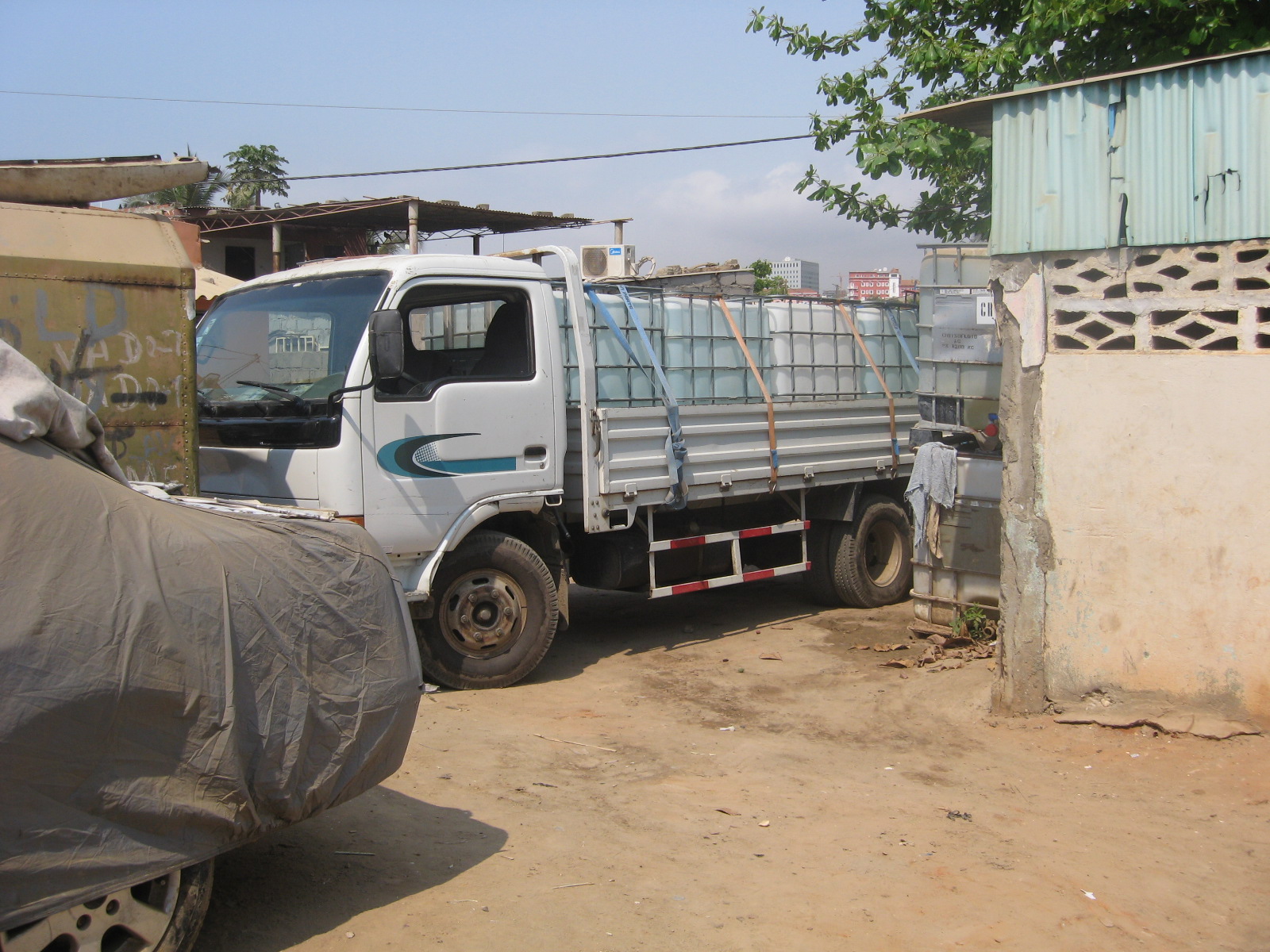
Distribution of water.1000 litres cost approximately 20 dollars
This is one way people get rid of waste, by burning it.
I don't intend to begin all my posts with the power status in the bairro, but I can't help doing that today... There is no power, nothing, nada, rien!! It's interesting to see how people here have learnt to deal with this quite well over the years. Yesterday, L.D. - who has always lived in Chicala – was telling me that this area until recently was not covered by this infrastructure at all. He said something about the government providing energy to bairros close to elections time...
Chicala is lacking many things. One has to live here to understand the dynamics of both people and space and how they manage to cope with all sorts of problems. And I am not just talking about the poor access to the bairro and people's houses, the complete lack of water, the constant blackouts, and the low quality of the built environment, it goes way beyond that. This particular area, as well as others in Luanda, is changing rapidly and people here are aware that, sooner or later, everyone will have to move out of Chicala. Where to? No-one seems to have an answer for that just yet. What they do know is that they will lose their current life, their references, livelihoods, and close contact with their neighbours and friends. Moreover, and because Chicala is so close to the city centre, the privilege of quickly getting to the city, where many of the people work, will also be lost.
I have been talking about this issue quite a lot with different people, and I can say that the feeling of uncertainty and insecurity towards their future is implicit in every word spoken.
A few days ago, I was told that this bairro will probably be demolished in about one year time (part of it is already gone). I can't help wondering what I will find here when I return to Angola, and where will these people be living...
I am still getting used to daily life here. Getting a full night sleep is particularly difficult, since there is always something happening somewhere - which usually involves music, or very loud music to be more accurate. Last night for example, there was another concert a few hundred metres from my house :) Of course there is no such thing as insulation or double glazing, so you hear pretty much everything as if it is happening inside your house. Oh, and let's not forget the noise coming from all the generators working at the same time when the power is off...
Last night I don't know why but I woke up at around 3am and could not sleep for another couple of hours... The nights are very hot and slightly uncomfortable, and all I could think about was how itchy the mosquito bites on my legs are!! I should probably try another type of insect repellent. The one I used in Ghana was completely useless and now I am beginning to think the same of the one I am currently using... I HATE MOSQUITOES!!!
On a more positive note, I was told about about 2 markets close-by where people usually buy all sorts of building materials to build their houses. Hopefully I'll manage to go there this or the following week, just to have a general idea of prices. From what I understand the only materials manufactured and sold within the neighbourhood are cement blocks. All the other stuff are mainly acquired in the markets.
02/10/2011
More photos
Today the power was off again... Apparently this is common on Sundays... Maintenance of the power plant, I told... It has become clear from these days alone that this is an issue, particularly in the bairros, where the infrastructure is weaker. The provision of energy is not reliable in Luanda. This helps to explain why every single person has a generator at home (I had not understood that before).
I am enjoying taking pictures of people around here. Everyone is incredibly photogenic and natural. I really wish I had a better camera with me... Here are a few more photos.
01/10/2011
30/09/2011
Missing the beach
No, this is not in Angola, unfortunately... I thought I would be able to take some time off and relax while I'm here, but now I realise that with all the work I still have to do, this will probably not happen. Oh well, I can always remember this beautiful beach in Ghana...
Still no power
This is the 3rd day without power... Hopefully this will be sorted soon...
Este é o 3.º dia sem electricidade... Espero que isto se resolva em breve...
29/09/2011
Lights out!
I landed in Luanda one week ago. In this short period of time – it feels much more than that – all sorts of things happened, but the result so far is very positive.
Today we experienced how it feels like to live without power. This area of Chicala was left in the dark (now I realise that it was a smart choice to buy a PC with a good battery life). Apparently the power cuts are very common here. The blackouts may range from few hours to days and there is little one can do apart from relying on a generator to keep the lights on after sunset.
Nevertheless, today was an interesting day. I spent the morning at Universidade Lusíada where I attended a lecture by architect Maurício Ganduglia with the theme "Characterization of Housing and Criteria for Comfort in Angola."
My first contact with Maurício happened when I was planning to visit Luanda in the beginning of this year, which unfortunately turned out not to happen. At the time, we talked about meeting up to exchange a few words about the work that he has been developing with local and natural building materials (mainly earth construction) in Angola. Now that I am finally in Luanda we will have the chance to catch up. In addition to that, my staying in Luanda coincides with the Universidade Lusíada's Academic Week, an event that aims to promote discussion and debate around various issues related to the built environment in Angola.
Today we experienced how it feels like to live without power. This area of Chicala was left in the dark (now I realise that it was a smart choice to buy a PC with a good battery life). Apparently the power cuts are very common here. The blackouts may range from few hours to days and there is little one can do apart from relying on a generator to keep the lights on after sunset.
Nevertheless, today was an interesting day. I spent the morning at Universidade Lusíada where I attended a lecture by architect Maurício Ganduglia with the theme "Characterization of Housing and Criteria for Comfort in Angola."
My first contact with Maurício happened when I was planning to visit Luanda in the beginning of this year, which unfortunately turned out not to happen. At the time, we talked about meeting up to exchange a few words about the work that he has been developing with local and natural building materials (mainly earth construction) in Angola. Now that I am finally in Luanda we will have the chance to catch up. In addition to that, my staying in Luanda coincides with the Universidade Lusíada's Academic Week, an event that aims to promote discussion and debate around various issues related to the built environment in Angola.
Maurício Ganduglia's lecture focused on the work and stusies on earthen construction recently carried out by the university and himself. This topic will be further discussed next week during the architecture forum. I am planning to attend so I shall bring this up again some time during next week.
By the way, during the lecture, before and after Maurício's intervention to be more accurate, there were two musical moments (as they put it) provided by a student and a teacher! Totally unexpected, but very interesting :) Nothing better to wake up the audience!
Tomorrow starts my week 2 in Angola. I'll return to Development Workshop's office for another meeting and hope to have time to go through some documents in their library.
By the way, during the lecture, before and after Maurício's intervention to be more accurate, there were two musical moments (as they put it) provided by a student and a teacher! Totally unexpected, but very interesting :) Nothing better to wake up the audience!
Tomorrow starts my week 2 in Angola. I'll return to Development Workshop's office for another meeting and hope to have time to go through some documents in their library.
Faz hoje uma semana que aterrei em Luanda. Neste curto espaço de tempo - que me parece já muito mais que isso - já me aconteceu um pouco de tudo, mas o saldo até agora é bastante positivo.
Hoje foi a vez de sentir o que é ficar sem energia. Esta zona da Chicala está às escuras (é nestas alturas que percebo que foi uma opção inteligente comprar um pc com uma boa bateria). As falhas de energia são comuns, assim me dizem, por aqui. Os apagões vão de horas a dias e pouco mais se pode fazer do que contar com o gerador de apoio para manter a luz acesa após o do pôr-do-sol.
Apesar disso, este foi um dia interessante. Passei a manhã na Universidade Lusíada onde assisti a uma palestra proferida pelo arquiteto Maurício Ganduglia, com o tema “Caracterização da Habitação e Critérios para o Conforto em Angola”.
O meu primeiro contacto com o arquiteto Maurício aconteceu ainda na altura em que eu pensava vir a Luanda no início deste ano que, infelizmente, acabou por não se concretizar. Ficámos de nos encontrar para trocarmos umas palavras sobre o trabalho que tem vindo a desenvolver com materiais de construção naturais e locais (sobretudo a construção com terra) em Angola. Agora, uns quantos meses após o plano inicial, deu-se a feliz oportunidade da minha estadia em Luanda coincidir com a semana académica da Universidade Lusíada, onde se estão a debater questões ligadas à arquitetura em Angola. A palestra do arquiteto Maurício abordou o trabalho que a universidade e ele próprio têm levado a cabo no sentido de sensibilizar os alunos e a população em geral para a potencialidade de construção com materiais locais e naturais. Na próxima semana irá decorrer o fórum de arquitetura onde se dará continuidade a esta discussão. Darei mais notícias entretanto, pois conto estar presente.
Aproveito só para fazer uma nota. Durante a palestra, aliás, antes e depois da intervenção do arquiteto Maurício Ganduglia, tivemos direito a dois momentos musicais proporcionados por um aluno e um professor!! Totalmente inesperado, mas muito interessante :) Nada melhor para fazer acordar audiências (e que acordados estavam!)!
Amanhã começa a semana Dois em Angola e o dia avizinha-se igualmente rico. Volto à Development Workshop para mais uma reunião e para consultar o fantástico arquivo de documentação que possuem na sua sede em Luanda.
27/09/2011
Why is Luanda the most expensive city in the world?
This label has been used as an excuse to raise prices of everything from a can of beans in the corner shop of Chicala to a night in a luxury hotel in the city centre.
Other cities in this list of 10 include Tokyo, Osaka and Hong Kong. Cities well known for their organisation and efficient provision of infrastructure. Luanda, although heading the list, reveals various needs at different levels. One could of course argue that the construction of infrastructure is still in its infancy but progressing well, and that the asymmetries felt in Angola's society will eventually disappear in the coming years, which would result in decent living conditions for those who want to live and /or work in Luanda. For now, however, the daily struggles just to get by in this African capital is a reality hard to ignore.
Yesterday I spoke with Director General of Development Workshop, an NGO that has been working in Angola, particularly amongst the poorest population, for many years. As a result of their work over here, they have developed a very comprehensive view of the problems experienced in the country. Allan Cain drew my attention to recent studies which indicate that a huge percentage of the built environment in Luanda (particularly in peri-urban areas) lacks the minimum conditions of habitability. Considering that about 2 / 3 of Luanda's population lives in the suburban neighbourhoods, I wonder what the future has reserved for Luanda's urban informal areas? The total area occupied by informal settlements is much more extensive than the formal city and the same happens with the number of people inhabiting there. Current proposals for urban requalification appear to orient themselves towards partial or total removal (demolition) of existing buildings, rather than improving current conditions. The former usually has a greater focus on the space itself - the urban fabric is completely renovated, and people are relocated elsewhere (with all the associated social consequences), while the latter typically tends to also incorporate the human variable in the equation - the space is improved / upgraded, without recourse to mass demolitions, avoiding the usual stress associated with displacing people.
Other cities in this list of 10 include Tokyo, Osaka and Hong Kong. Cities well known for their organisation and efficient provision of infrastructure. Luanda, although heading the list, reveals various needs at different levels. One could of course argue that the construction of infrastructure is still in its infancy but progressing well, and that the asymmetries felt in Angola's society will eventually disappear in the coming years, which would result in decent living conditions for those who want to live and /or work in Luanda. For now, however, the daily struggles just to get by in this African capital is a reality hard to ignore.
Yesterday I spoke with Director General of Development Workshop, an NGO that has been working in Angola, particularly amongst the poorest population, for many years. As a result of their work over here, they have developed a very comprehensive view of the problems experienced in the country. Allan Cain drew my attention to recent studies which indicate that a huge percentage of the built environment in Luanda (particularly in peri-urban areas) lacks the minimum conditions of habitability. Considering that about 2 / 3 of Luanda's population lives in the suburban neighbourhoods, I wonder what the future has reserved for Luanda's urban informal areas? The total area occupied by informal settlements is much more extensive than the formal city and the same happens with the number of people inhabiting there. Current proposals for urban requalification appear to orient themselves towards partial or total removal (demolition) of existing buildings, rather than improving current conditions. The former usually has a greater focus on the space itself - the urban fabric is completely renovated, and people are relocated elsewhere (with all the associated social consequences), while the latter typically tends to also incorporate the human variable in the equation - the space is improved / upgraded, without recourse to mass demolitions, avoiding the usual stress associated with displacing people.
It is obviously very difficult to indicate which is the best or worst solution for Angola generally and Luanda in particular. The specific case of Angola, which has only recently found peace after a war of more than 30 years – still very much present in everyone's mind -, makes prescribing solutions for urban requalification even more complex. The risk of failure in the face of overwhelming problems is definitely an issue.
Experience tells us that each case is unique and different contexts will always require different and very context-specific solutions. However, one can always observe what has been done worldwide to overcome similar problems and learn from either previous success of failure... Following this, it is also vital to learn from strategies implemented within the country and learn with every step, so that mistakes are not repeated.
Despite all of this, and possibly because of very rapid economic growth in Angola, when travelling to Luanda one will find a city where buying or renting a house necessarily involves spending a small fortune. Where essential products are much more expensive than in other countries. Where one will pay more to buy 1lt of mineral water than to buy the same amount of gasoline and where everything is accounted in dollars. Luanda is becoming a modern city. Hundreds of cranes are now part of the city's silhouette, announcing the birth of the same number of skyscrapers. At the same time, garbage piles up on the streets of the musseques, water does not reach people's houses and at times the roads are almost impassible.
This is Luanda. Luanda is beautiful. Luanda is very rich, so rich that everyone wants to stay here. Luanda is poor, so poor that everyone wants to leave.
Luanda tem disto. Um rótulo que tem servido com pretexto para elevar preços de tudo, desde uma lata de feijão numa cantina da Chicala a uma noite no hotel de luxo no centro da cidade.
Outras cidades nesta lista das 10 magníficas incluem Tóquio, Osaka ou Hong Kong, cidades sobejamente conhecidas pela sua organização e eficiente funcionamento das suas infraestruturas. Luanda, embora encabece a lista, transpira carências aos mais diversos níveis. Pode obviamente argumentar-se que a construção de infraestruturas se encontra numa fase embrionária mas a avançar a bom ritmo e que nos próximos anos as assimetrias da sociedade acabarão por se esfumar, oferecendo assim condições de vida condignas para quem deseja habitar e/ou trabalhar em Luanda.
Por enquanto, todavia, a necessidade de travar lutas diárias para viver o dia-a-dia nesta capital africana é uma realidade difícil de ignorar.
Ontem falava com o Diretor Geral da Development Workshop, uma ONG que há já largos anos se tem dedicado a desenvolver trabalho em Angola junto de populações mais carenciadas. Como resultado do seu trabalho por cá, desenvolveram uma visão bastante abrangente das problemáticas vividas em Angola. Allan Cain chamou-me a atenção para estudos recentemente realizados que indicam que uma percentagem enorme do parque edificado em Luanda, sobretudo nas zonas peri-urbanas, não apresenta as condições mínimas de habitabilidade. Ora, considerando que cerca de 2/3 da população de Luanda reside nestes bairros suburbanos, pergunto qual será o futuro deste tecido urbano informal, que em área é muito mais extenso que a cidade formal, assim como das populações que aqui residem. Propostas atuais de requalificação urbana parecem orientar-se no sentido de eliminação parcial ou total (demolição) do edificado existente, ao invés de melhoramento das condições atuais. Sendo que o o primeiro normalmente tem um maior enfoque no espaço em si – o tecido urbano é completamente renovado, e as populações são realojadas noutro local (com todas as consequências sociais associadas), enquanto que o segundo por norma tende a incorporar também a variável humana na equação – o espaço é melhorado/requalificado, sem recurso a demolições em massa, e o stress da deslocação da população é evitado.
É obviamente muito difícil afirmar com certeza qual é a melhor ou pior solução. O caso particular de Angola, que só recentemente encontrou paz após uma guerra de mais de 30 anos, torna a prescrição de soluções de requalificação urbana ainda mais complexa. Certo que cada caso é um caso e diferentes contextos obrigam a que se adotem diferentes soluções, no entanto, talvez seja acertado observar o que se tem feito mundo fora, perceber porque alguns casos tiveram franco sucesso e porque outros falharam redondamente... Portanto, antes de mais aprender com os outros, e depois, à medida que se implementam estratégias já no país, aprender a cada passo dado, para que não se repitam erros cometidos.
Independentemente de tudo isto, possivelmente porque o rápido crescimento económico em Angola assim o permite, quando se viaja para Luanda encontra-se uma cidade onde comprar ou alugar uma casa obriga a que se possua uma pequena fortuna. Onde os produtos essenciais, e não só, são bem mais caros que noutros países. Onde ao comprar 1lt de água mineral se gasta mais que a comprar a mesma quantidade de gasolina e onde tudo se conta em dólares. Luanda é uma cidade a modernizar-se. Centenas de gruas desenham hoje a silhueta da cidade, anunciando o nascimento do mesmo número de arranha-céus. Ao mesmo tempo, acumulam-se pilhas de lixo pelos bairros, onde se vive um dia-a-dia sem água canalizada e onde se chega a casa por estradas quase intransitáveis. Luanda tem disto. Luanda é muito rica, tão rica que todos cá querem ficar. Luanda é pobre, tão pobre que todos querem sair.
Luanda tem disto. Um rótulo que tem servido com pretexto para elevar preços de tudo, desde uma lata de feijão numa cantina da Chicala a uma noite no hotel de luxo no centro da cidade.
Outras cidades nesta lista das 10 magníficas incluem Tóquio, Osaka ou Hong Kong, cidades sobejamente conhecidas pela sua organização e eficiente funcionamento das suas infraestruturas. Luanda, embora encabece a lista, transpira carências aos mais diversos níveis. Pode obviamente argumentar-se que a construção de infraestruturas se encontra numa fase embrionária mas a avançar a bom ritmo e que nos próximos anos as assimetrias da sociedade acabarão por se esfumar, oferecendo assim condições de vida condignas para quem deseja habitar e/ou trabalhar em Luanda.
Por enquanto, todavia, a necessidade de travar lutas diárias para viver o dia-a-dia nesta capital africana é uma realidade difícil de ignorar.
Ontem falava com o Diretor Geral da Development Workshop, uma ONG que há já largos anos se tem dedicado a desenvolver trabalho em Angola junto de populações mais carenciadas. Como resultado do seu trabalho por cá, desenvolveram uma visão bastante abrangente das problemáticas vividas em Angola. Allan Cain chamou-me a atenção para estudos recentemente realizados que indicam que uma percentagem enorme do parque edificado em Luanda, sobretudo nas zonas peri-urbanas, não apresenta as condições mínimas de habitabilidade. Ora, considerando que cerca de 2/3 da população de Luanda reside nestes bairros suburbanos, pergunto qual será o futuro deste tecido urbano informal, que em área é muito mais extenso que a cidade formal, assim como das populações que aqui residem. Propostas atuais de requalificação urbana parecem orientar-se no sentido de eliminação parcial ou total (demolição) do edificado existente, ao invés de melhoramento das condições atuais. Sendo que o o primeiro normalmente tem um maior enfoque no espaço em si – o tecido urbano é completamente renovado, e as populações são realojadas noutro local (com todas as consequências sociais associadas), enquanto que o segundo por norma tende a incorporar também a variável humana na equação – o espaço é melhorado/requalificado, sem recurso a demolições em massa, e o stress da deslocação da população é evitado.
É obviamente muito difícil afirmar com certeza qual é a melhor ou pior solução. O caso particular de Angola, que só recentemente encontrou paz após uma guerra de mais de 30 anos, torna a prescrição de soluções de requalificação urbana ainda mais complexa. Certo que cada caso é um caso e diferentes contextos obrigam a que se adotem diferentes soluções, no entanto, talvez seja acertado observar o que se tem feito mundo fora, perceber porque alguns casos tiveram franco sucesso e porque outros falharam redondamente... Portanto, antes de mais aprender com os outros, e depois, à medida que se implementam estratégias já no país, aprender a cada passo dado, para que não se repitam erros cometidos.
Independentemente de tudo isto, possivelmente porque o rápido crescimento económico em Angola assim o permite, quando se viaja para Luanda encontra-se uma cidade onde comprar ou alugar uma casa obriga a que se possua uma pequena fortuna. Onde os produtos essenciais, e não só, são bem mais caros que noutros países. Onde ao comprar 1lt de água mineral se gasta mais que a comprar a mesma quantidade de gasolina e onde tudo se conta em dólares. Luanda é uma cidade a modernizar-se. Centenas de gruas desenham hoje a silhueta da cidade, anunciando o nascimento do mesmo número de arranha-céus. Ao mesmo tempo, acumulam-se pilhas de lixo pelos bairros, onde se vive um dia-a-dia sem água canalizada e onde se chega a casa por estradas quase intransitáveis.
Luanda tem disto. Luanda é linda. Luanda é muito rica, tão rica que todos cá querem ficar. Luanda é pobre, tão pobre que todos querem sair.
26/09/2011
"This is Africa"
I have been hearing this sentence since I first set foot in Angola, whenever something out of the ordinary happens. There is a concert taking place literally next to my house, since at least 9pm (it's now 1.15 am). Don't think it will stop any time soon. :) Oh well... At least it's nice African music!
My 'landlord' is telling me "This is Africa my friend, you will remember this when you're gone". I am sure I will... This and much more...
23/08/2011
Rural Studio - Why aren't all architecture schools like this?
Just a few days ago a friend and colleague architect told me about this wonderful thing called "the Rural Studio". It basically consists of a different and revolutionary way of teaching and doing architecture, in which students are made aware of the social responsabilities of the profession of the architect while providing homes to poor communities in Alabama.
The Rural Studio is part of Auburn University and was created in 1993 with the intention of teaching architecture by combining theory and practice and apply them to local real life situations, i.e., hands-on experience focused on improving living condition of people in an impoverished area of Alabama. The Rural Studio's concept is not complicated at all, in fact it is as simple as it can get: teach students about architecture and the built environment, from design to construction, and get them deeply involved in every step of the way. I wonder why this is not done more often?...
My friend E. also told me all about the huge success of this programme, which helps to explain the long waiting list of people from all over the world who wish to attend the course. I can easily relate to them... A few years ago, when I was studying architecture one of the things that I criticised was the lack of hands-on experience - and I am not just talking about learning how to design buildings but also how to actually construct them.
If you are interested you can read more about the Rural Studio HERE and HERE.
The Rural Studio is part of Auburn University and was created in 1993 with the intention of teaching architecture by combining theory and practice and apply them to local real life situations, i.e., hands-on experience focused on improving living condition of people in an impoverished area of Alabama. The Rural Studio's concept is not complicated at all, in fact it is as simple as it can get: teach students about architecture and the built environment, from design to construction, and get them deeply involved in every step of the way. I wonder why this is not done more often?...
My friend E. also told me all about the huge success of this programme, which helps to explain the long waiting list of people from all over the world who wish to attend the course. I can easily relate to them... A few years ago, when I was studying architecture one of the things that I criticised was the lack of hands-on experience - and I am not just talking about learning how to design buildings but also how to actually construct them.
If you are interested you can read more about the Rural Studio HERE and HERE.
11/08/2011
Next chapter - restoring our earthen house
east elevation
east and north elevations
south and east elevations
view from the top of the hill
After one year of going back and forth and dealing with the usual bureaucracy we can finally can call this bit of land in Alentejo (Portugal) ours! The next step, which should take another year, is restoring the house and make the place liveable so that we can move back to Portugal for good!
The plan is to start the building process with a composting toilet and a shower outside, and then crack on full power with the house. I would like to organise a few workshops during different stages of the construction, so that the community - and others interested - can be involved in the process. Probably the composting toilet will be the first of these series of workshops, but I shall post further info here about the workshop when everything is properly arranged.
The rammed earth walls will all be replaced, as well as the roof. The foundations appear to be in a very good condition and there is a beautiful slate oven on the south façade that we will of course keep (I can already imagine the bread I’ll bake there).
In the future, the plan is also to build an eco swimming pond or natural swimming pool, however, from what I gathered from the prices, this will have to wait a bit more...
So, for now the focus is entirely on the house. Myself and my partner are fully aware that this will be quite a challenge, but surely a rewarding one! We cannot wait to start ramming the earth!!
The plan is to start the building process with a composting toilet and a shower outside, and then crack on full power with the house. I would like to organise a few workshops during different stages of the construction, so that the community - and others interested - can be involved in the process. Probably the composting toilet will be the first of these series of workshops, but I shall post further info here about the workshop when everything is properly arranged.
The rammed earth walls will all be replaced, as well as the roof. The foundations appear to be in a very good condition and there is a beautiful slate oven on the south façade that we will of course keep (I can already imagine the bread I’ll bake there).
In the future, the plan is also to build an eco swimming pond or natural swimming pool, however, from what I gathered from the prices, this will have to wait a bit more...
So, for now the focus is entirely on the house. Myself and my partner are fully aware that this will be quite a challenge, but surely a rewarding one! We cannot wait to start ramming the earth!!
Any updates will be posted here.
11/07/2011
3 years!
Three years have passed and it still seems like yesterday that I posted here for the first time.
20 000 visits from all over the world may not seem much (I have seen blogs with much more than that!), but it is certainly enough to keep me going :) And I have you to thank for that.
This year will be a very exciting one to post: as I head towards the final stage of my research I will spend some time in Ghana and Angola from September and hopefully will also start sharing thoughts, ideas and pictures on the construction of my own little earthen house in Portugal... So, please do stop by, your visit is, as always, more than welcome!
See you soon!!
20 000 visits from all over the world may not seem much (I have seen blogs with much more than that!), but it is certainly enough to keep me going :) And I have you to thank for that.
This year will be a very exciting one to post: as I head towards the final stage of my research I will spend some time in Ghana and Angola from September and hopefully will also start sharing thoughts, ideas and pictures on the construction of my own little earthen house in Portugal... So, please do stop by, your visit is, as always, more than welcome!
See you soon!!
05/07/2011
27/06/2011
Earthen buildings today...
A few weeks ago I have received a link to Patricio Arias new website, which made me think about what it meant to build with earth today.
Patricio Arias is an architect from Chile who is definitely amongst the group of very talented people – such as Rick Joy, Plano B, Martin Rauch, Marcelo Cortes (with whom he has worked) – looking at the current use of earthen materials as a product of our time and, therefore, bringing earth as a building material to the mainstream of the building industry.
Although I still struggle a bit with the concept of ‘contemporary earthen architecture’ (I shall leave this issue to a later post), I have to say that I have seen quite a lot of examples of buildings that would qualify as such. However, Patricio’s approach differs substantially from all of what is already out there.
I met Patricio in a conference last year and have been following his work ever since. I was able to witness his enormous passion for architecture in general and, in particular, for the way earth can be used to meet current needs and demands. Patricio Arias’ work reveals a deep understanding of both architectural space and the essence of building materials. Moreover, he makes a clear statement with his buildings by proclaiming to the world that it is possible to create extraordinary architecture with earth, using one or several of its many associated construction techniques. His architecture emerges from within its time and context, and reveals that, no matter what the future brings in terms of fashion or architectural styles, the same approach can be pursued and successfully accomplished.
As always, some criticism has also been made about the use of the main technique used by Patricio – tecnobarro (or quincha metalica). This was mostly to do with the introduction of steel as a structure for the earthen walls. Those who are more “purists” in what concerns the use of earth as building material often question the compatibility of earth with concrete or steel. In a way I can understand this concern, especially since there are complex chemical processes involved in the heat and humidity transfer of unbaked earthen materials. This is the reason why, for example, one usually combines natural insulating materials (such as cork or sheep wool) with earthen building elements. Nevertheless, I am not aware of any studies that have been carried out in order to test this theory. I had this same conversation with Patricio, who was very interested in finding out whether the thermal performance of the buildings he designs is in any way influenced by the use of steel.
In addition to the thermal performance, I would probably add a very current issue – the ecological footprint and environmental impact of quincha buildings. Apparently, the overall sustainability of these buildings may be somewhat compromised, due to the energy intensive overall construction process (when compared to traditional earthen building techniques). Not only some of the materials have a high embodied energy, but also mechanical methods are used throughout.
Again, I am certainly not an expert in this type of earthen technology, nor can I refer to any study that has been carried out to share some light on this particular subject; however, one has to wonder about the viability of applying this technique to other, perhaps not so resourceful, contexts.
While some features may be questioned, others are without a doubt, very positive. This consists of a very effective seismic resistant construction. Once more, I refer to what Patricio stated himself after the last major earthquake in Chile: his houses were not affected, whereas others have literally crumbled apart.
In my opinion, we do not always have to have a definite answer or solution for every problem encountered, there is no such thing as a universal thruth... Patricio’s buildings are incredibly interesting and appealing as architectural objects. One cannot help but feeling fascinated by them. Further to this, they bear witness to the immense possibilities and flexibility of this building material and probably are providing a view into what the future of earthen materials will be.
The main question raised here, which can easily be applied to a more general architectural universe, is whether or not the future of earthen buildings will still be one of sustainability above all? By employing mechanical processes, are we contributing towards the increase of CO2 emissions? Will that also mean that earthen buildings will not be as low-cost as they are known for? Who will be able to afford these high-quality earthen houses?
On the other hand, I can also envisage a myriad of positive aspects arising from the combination of modern technologies with such an ancient building material. One only has to look at the photos below to understand that the preconceived ideas that usually associate earth with backwardness and poorness are indeed obsolete. And this, my fellow readers, the social perception, has been the paramount obstacle against the use of earthen materials today.
For this reason, and just to conclude for today, it is my belief that if it takes a bit of a compromise in order for people to accept once and for all that “earthen architecture” is just Architecture, then I am not against some kind of hybrid approach, where one can make use of the good natural features of earth and today’s technological advances in the field of architecture and engineering.
See you soon!
Some examples of buildings designed by Patricio Arias. All images have been sourced from his website http://www.patricioarias.cl/Index.php/
Subscribe to:
Posts (Atom)